In recent years, interest in structured spiritual education has grown beyond casual curiosity. A modern Palmistry Course is no longer viewed only as a mystical hobby. Many learners now approach palm reading with the same mindset used in psychology, behavioral studies, symbolic interpretation, and intuitive counselling.
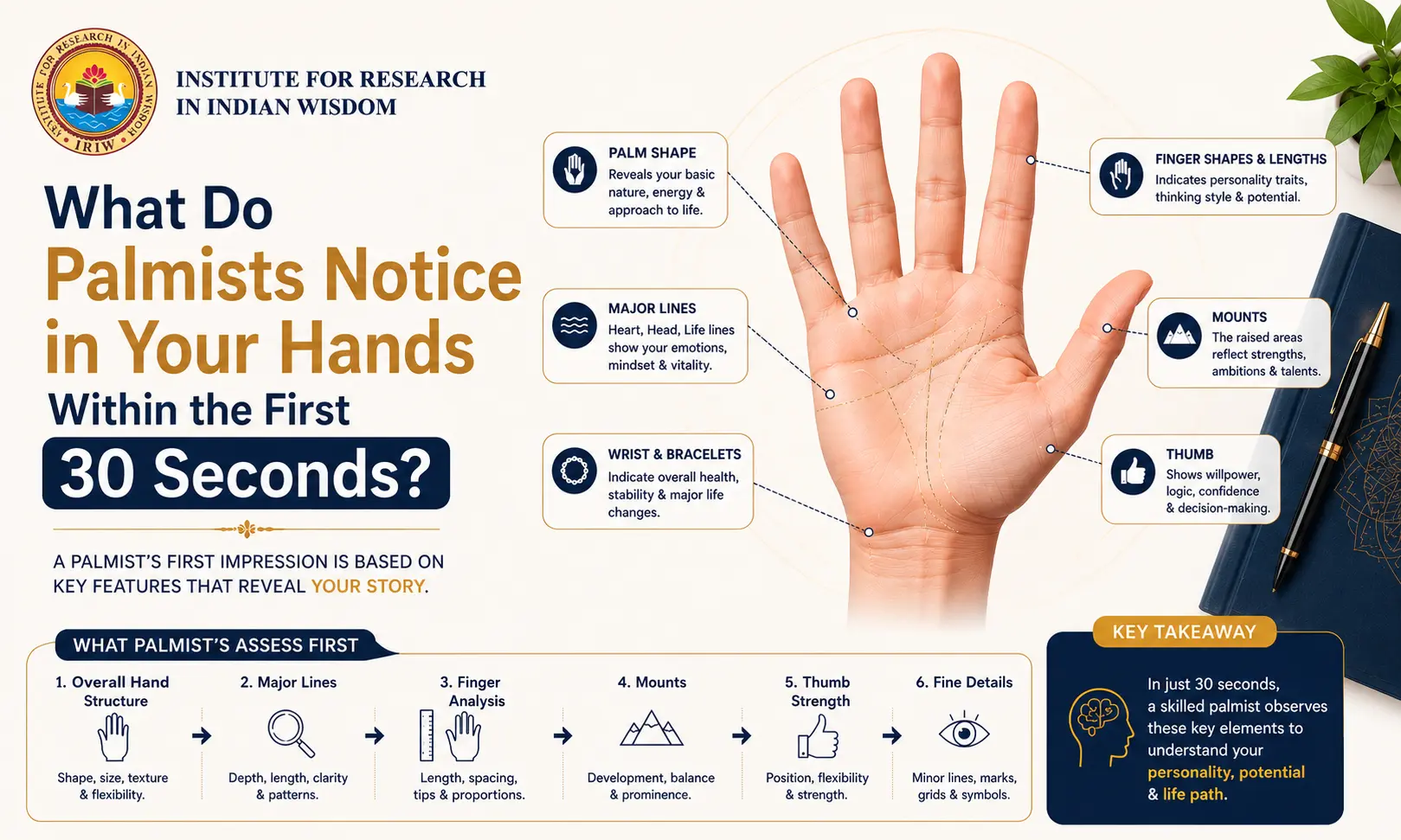
What is often overlooked, however, is how experienced palmists actually begin their observations. Contrary to popular assumptions, the first 30 seconds are rarely about predicting dramatic life events. Instead, trained practitioners focus on patterns, structure, proportion, texture, movement, and behavioural indicators that help establish an initial reading framework.
That early assessment stage reveals something important about palmistry education itself. The quality of interpretation depends less on memorising isolated meanings and more on developing disciplined observational ability.
Institutions such as IRIW have contributed to this shift by presenting palmistry through more structured learning models rather than purely folklore-driven explanations. The field increasingly attracts learners who want methodical understanding rather than vague predictions.
Palmistry has historically existed at the intersection of symbolic traditions, behavioral interpretation, and cultural philosophy. While popular media often portrays it as instant fortune telling, professional practitioners generally approach it as a layered interpretive discipline.
A noticeable trend across India is the movement toward formalized learning environments. Students evaluating a Palmistry Course today often compare:
This change mirrors patterns seen in many traditional knowledge sectors. Informal learning still exists, but structured instruction increasingly becomes important as learners seek consistency and credibility.
Another important observation is that beginners frequently focus too heavily on lines alone. Experienced palmists, however, understand that hand reading involves a broader assessment system involving:
That broader analytical process is often where a well-designed Palmistry Course becomes valuable.
For learners exploring structured educational pathways, IRIW maintains broader institutional information through its About us page.
A Palmistry Course is a structured educational program that teaches the interpretation of hand shapes, lines, mounts, finger structures, and symbolic patterns used in palm reading. Modern courses often combine traditional palmistry principles with observational techniques, practical case analysis, and interpretive methodology.
Within the first 30 seconds, experienced palmists usually assess hand shape, flexibility, skin texture, finger proportions, dominant hand characteristics, and overall balance before analyzing individual lines. These initial observations help establish personality tendencies, behavioral patterns, and interpretive context for deeper reading.
Although palmistry is interpretive in nature, experienced practitioners still rely on systematic observation models. Most structured Palmistry Course programs organize learning into layered analytical stages.
1. Hand Shape Classification
One of the earliest assessments involves identifying elemental hand categories:
These categories help establish foundational behavioral tendencies.
For example:
| Hand Type |
Common Characteristics |
|
Earth |
Practical, grounded, steady |
|
Air |
Analytical, intellectual, communicative |
|
Fire |
Energetic, expressive, impulsive |
|
Water |
Emotional, intuitive, sensitive |
This framework is often misunderstood as rigid classification. In reality, experienced readers look for blended characteristics rather than isolated categories.
2. Finger Structure Analysis
Palmists also assess:
These indicators are viewed as symbolic behavioral markers rather than deterministic traits.
3. Palm Texture & Skin Quality
Interestingly, texture observation plays a larger role than many beginners expect.
A coarse palm may suggest practical engagement, while softer textures are sometimes associated with sensitivity or imaginative tendencies. Professional instruction generally teaches students to avoid simplistic conclusions and instead evaluate combinations of features.
Unlike product manufacturing industries, the “production methodology” in palmistry education relates to interpretive training systems and instructional design.
A thoughtful Palmistry Course typically develops skills through progressive learning stages:
Students begin by understanding:
At this stage, learners start identifying how multiple indicators interact together. This is where observational discipline becomes important.
Experienced instructors often emphasize that isolated interpretations create inconsistent readings. Meaning develops through pattern relationships.
Many learners underestimate how difficult real-world hand observation can be.
Lighting conditions, hand posture, flexibility variations, and natural asymmetry all affect interpretation. Practical exposure helps students move beyond textbook diagrams into real observational work.
One pattern seen among advanced practitioners is restraint. Strong readers avoid exaggerated certainty.
This is an important distinction between entertainment-driven palmistry and more disciplined interpretive approaches taught in structured learning environments.
The durability of palmistry knowledge depends heavily on training quality and practice methodology.
A short-term memorization approach usually produces shallow interpretation skills. By contrast, structured programs focus on:
Many experienced learners eventually realize that palmistry resembles behavioural pattern study more than prediction performance.
That shift in understanding often changes how students evaluate a Palmistry Course altogether.
Rather than asking:
“Will this teach predictions quickly?”
More thoughtful learners ask:
“Will this improve interpretive accuracy and observation depth over time?”
That distinction matters.
Palmistry education attracts a diverse range of learners across India.
Common learner profiles include:
Some students pursue learning for professional consultation purposes, while others approach it as personal knowledge development.
The learning environment also affects outcomes significantly.
Structured institutions generally provide:
Independent self-learning, while accessible, often leads to fragmented understanding without comparative evaluation.
Different learning formats exist within the palmistry education space. Each has advantages depending on learner goals.
Learning Format |
Strengths |
Limitations |
|
Self-study books |
Flexible pace |
Limited correction |
|
Online recorded courses |
Convenient access |
Reduced interaction |
|
Live classroom learning |
Real-time feedback |
Schedule dependency |
|
Structured institutional programs |
Curriculum consistency |
Requires commitment |
There is no universally superior format. The appropriate choice depends on:
Before enrolling in a Palmistry Course, learners often benefit from evaluating several practical factors carefully.
Curriculum Depth
Does the course move beyond basic line memorization?
Practical Observation Training
Are students exposed to real hand analysis practice?
Teaching Methodology
Is interpretation taught systematically or through vague symbolism?
Instructor Experience
Does the faculty demonstrate analytical consistency?
Learning Progression
Is the program structured from beginner to advanced levels?
Interpretive Balance
Does the course avoid exaggerated predictive claims?
Long-Term Support
Are learners able to revisit concepts, case discussions, or guidance later?
Thoughtful evaluation reduces disappointment and improves learning alignment.
Basic concepts can be learned within weeks, but interpretive accuracy usually develops through continuous observation and practice over months or years. Structured learning programs often accelerate understanding by organizing concepts systematically.
No. Experienced palmists also evaluate hand shape, finger structure, flexibility, mounts, texture, nail condition, and proportional balance before analyzing major lines.
Yes. Most structured palmistry programs begin with foundational concepts and gradually move toward advanced interpretation methods and practical analysis techniques.
Casual reading often focuses on isolated meanings or entertainment-style predictions. Professional training generally emphasizes observation discipline, symbolic correlation, interpretive consistency, and practical case evaluation.
Yes. Practical observation helps learners understand variations that are difficult to capture through diagrams or theoretical explanations alone.
Palmistry education demand is no longer limited to major metropolitan areas. Interest now extends across Tier-2 and Tier-3 cities as learners seek structured spiritual and symbolic education programs.
Institutions operating on a Pan-India basis increasingly adapt through:
IRIW reflects this broader accessibility trend through its educational presence across multiple regions while maintaining centralized learning structures and curriculum consistency.
One interesting pattern across the industry is that learners today tend to verify institutional credibility more carefully than before. They compare course structure, teaching clarity, and long-term learning support rather than relying solely on promotional claims.
That shift has gradually improved overall expectations within the palmistry education segment.
The first 30 seconds of palm observation reveal something deeper than symbolic interpretation alone. They reflect how trained practitioners organize visual information, assess behavioural indicators, and establish analytical context before drawing conclusions.
This is precisely why structured learning matters.
A well-designed Palmistry Course does not simply teach meanings. It develops observational discipline, interpretive reasoning, and symbolic consistency over time.
As interest in structured spiritual education continues to grow across India, learners are becoming more thoughtful in how they evaluate educational quality, instructional depth, and practical applicability.
If you are evaluating this field for personal learning or professional development, reviewing course methodology, interpretive structure, and practical training exposure carefully can help avoid learning gaps later. For additional educational guidance or program-related information, you can connect with the team at IRIW Contact us page.