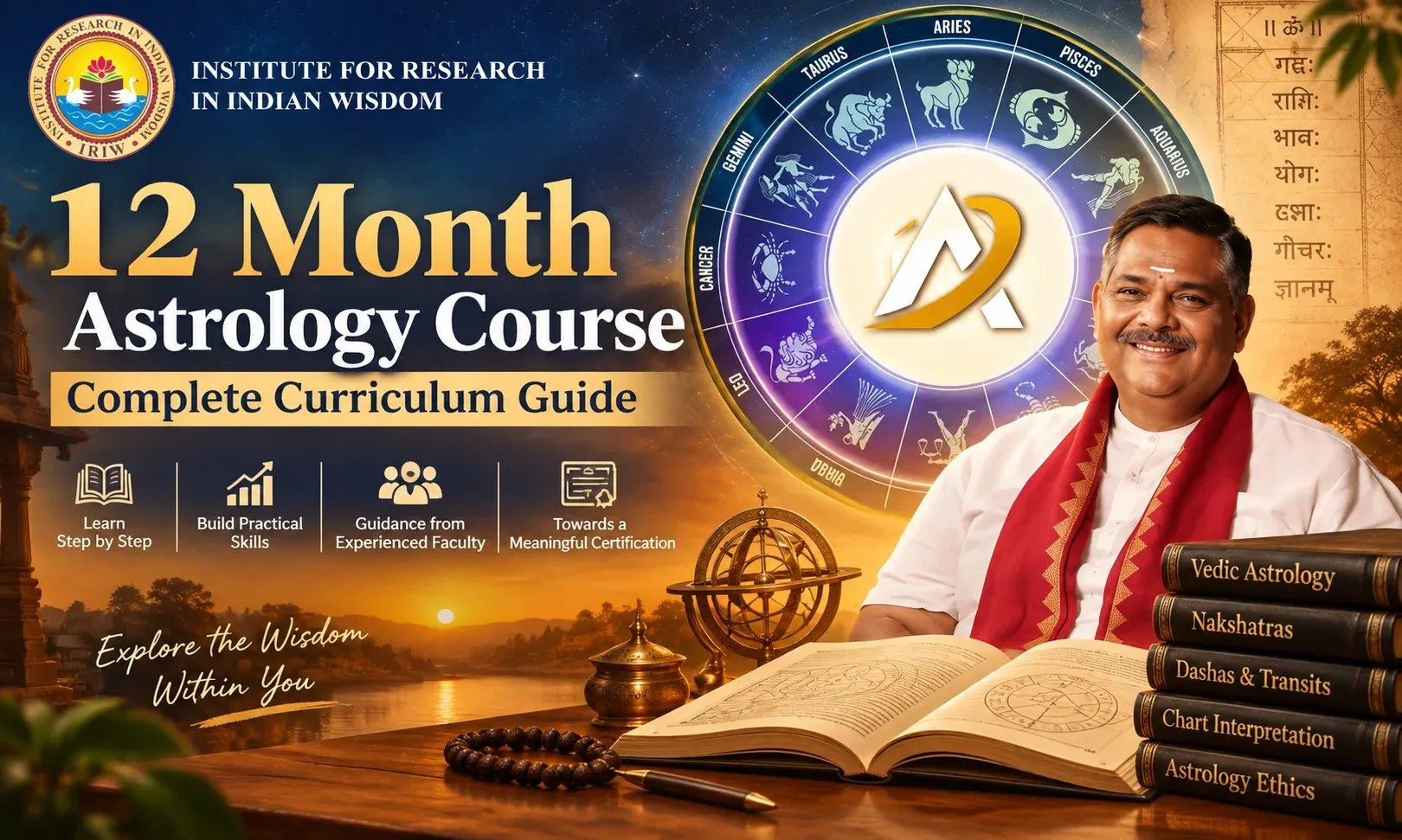
A 12 month astrology course gives learners enough time to move beyond isolated definitions and develop a structured method of chart interpretation. A well-designed programme should begin with zodiac signs, planets, houses and chart orientation, then progress towards nakshatras, yogas, dashas, transits, divisional charts, case studies and consultation ethics. The real advantage of a year-long course is not simply the number of topics covered. It is the time available to practise, receive feedback and connect different chart factors without rushing.
For someone comparing an advanced astrology course, the curriculum matters more than an impressive course title. Prospective students should examine the teaching sequence, class hours, faculty access, practice requirements, assessment method and certification terms. They should also distinguish between learning traditional interpretive methods and receiving a guarantee of professional success or perfectly accurate predictions.
This guide explains what a realistic 12 month astrology course can include, how the curriculum may progress month by month and what outcomes learners can reasonably expect. The roadmap is an educational model, not a reproduction of IRIW's current official syllabus. IRIW presently describes its advanced course as a 15-month programme, so applicants should confirm the latest duration and module sequence directly with the institute.
A 12 month astrology course is a structured programme that develops foundational, intermediate and advanced chart-reading skills over approximately one year. In a Vedic astrology setting, learners may study rashis, grahas, bhavas, nakshatras, planetary strength, yogas, dashas, gochar or transits, divisional charts and methods of synthesis. Professional astrology training may also include assignments, live chart analysis, client communication and ethical practice.
The duration alone does not make a course advanced. A credible programme defines learning outcomes and gives students repeated opportunities to apply concepts. Twelve months can support meaningful progress when classes are regular and learners revise consistently, but mastery still depends on prior knowledge, teaching quality, supervised practice and continued study after certification.
Astrology is a traditional interpretive discipline rather than an evidence-based substitute for medical, legal, financial or mental-health advice. Responsible training should teach uncertainty, privacy and clear limits alongside interpretation techniques.
A year-long course can suit serious beginners, learners who have completed a foundation programme, practising astrologers seeking a more systematic method and people exploring astrology as a future profession. It may also suit working professionals, retirees, counsellors, writers and researchers interested in Indian knowledge traditions, provided they can commit time to revision and chart practice.
Before joining an advanced astrology course, check the stated entry level. Some programmes begin from first principles, while others assume that students already understand signs, planets, houses and basic chart construction. Joining above your current level can create gaps that become harder to correct later.
Twelve months can build a strong working foundation and improve chart-reading confidence, but it does not automatically make every graduate ready for independent professional practice. A committed learner may become able to organise a chart analysis, compare multiple indicators, use introductory timing methods and present a careful written interpretation. Professional readiness requires more than completing lessons.
Students also need supervised cases, communication skills, accurate record keeping, consent practices and the judgement to decline questions beyond their competence. The number of charts studied, the quality of feedback and the learner's ability to explain the reasoning behind an interpretation are better measures of progress than the calendar alone.
The following roadmap shows how a balanced curriculum may progress. Exact topics, terminology and sequence vary by institute and lineage.
| Phase | Months | Main focus | Expected outcome |
|---|---|---|---|
| Foundation | 1 to 3 | Chart structure, signs, planets, houses and ascendant | Read the chart layout and use basic terminology correctly |
| Interpretation | 4 to 6 | House lords, planetary condition, aspects, nakshatras and yogas | Connect several chart factors into a supported observation |
| Prediction | 7 to 9 | Dashas, transits, divisional charts and event timing | Apply introductory timing methods with appropriate caution |
| Practice | 10 to 12 | Case studies, consultation skills, ethics, assessment and portfolio | Deliver structured readings and identify professional limits |
The first quarter should create a common language. Month one can introduce the relationship between astronomy and astrology, birth data, time zones, ayanamsha or system settings, the ascendant and common North Indian or South Indian chart formats. Students should learn how inaccurate time or location data can change a chart and why software output must be checked before interpretation begins.
Month two can focus on the twelve zodiac signs and the grahas. Instead of memorising long lists, learners should compare elements, modalities, rulerships, natural significations and context-dependent expression. Month three can introduce the twelve houses, house groupings and house lords. Short exercises should require students to locate a planet, identify the sign and house, and explain the difference between natural significance and functional role.
Month four may develop planetary condition through dignity, combustion, retrogression, conjunctions and aspects according to the method being taught. Students should learn that no factor works in isolation and that different schools may define strength or aspect differently. A good teacher states the chosen framework clearly and applies it consistently.
Month five can introduce nakshatras, their rulers, basic qualities and their place within chart interpretation. Month six may cover selected yogas and chart synthesis. The objective is not to collect hundreds of combinations but to evaluate whether a yoga is actually formed, supported and relevant. Guided worksheets can help learners move from a placement-by-placement reading to a coherent chart narrative.
Month seven can introduce dasha systems, including the purpose of planetary periods and the logic used to assess a period lord. Students should practise identifying the running periods and linking them to natal promise without making absolute claims. Month eight may add transits, showing how current planetary movement is considered alongside the birth chart and dasha context.
Month nine can introduce selected divisional charts and event-timing practice. Learners should understand what each taught varga is intended to examine and why divisional charts should not be interpreted without the natal chart. Case discussions are essential because prediction methods become meaningful only when students learn to weigh agreement, contradiction and uncertainty across several indicators.
Month ten can centre on real or anonymised case studies covering themes such as education, work, relationships and major life transitions. Students should document the question, relevant chart factors, timing indicators, alternative explanations and limits of the conclusion. This creates a repeatable process instead of intuition without evidence.
Month eleven should address consultation structure, listening, consent, confidentiality and responsible language. Learners need practice translating technical observations into understandable statements without fear, certainty or dependency. Sensitive health, legal, investment and psychological questions should be referred to appropriately qualified professionals.
Month twelve can consolidate the programme through revision, a practical assessment, portfolio review or supervised presentation. The final evaluation should test reasoning, not only memory. Students may analyse an unfamiliar chart, explain their method, answer questions and identify what they cannot responsibly conclude. A clear development plan can then guide further study after the course.
Course pages often list many advanced subjects, but a long syllabus does not prove that learners can apply them. Practical training should begin early and increase gradually. Students can start by identifying chart components, progress to short written observations and later complete timed case analyses or supervised consultations.
Useful feedback explains why reasoning is strong or weak. It should identify missed factors, unsupported claims, inconsistent technique and unclear communication. Peer discussion can broaden perspective, but faculty correction remains important when learners are building a professional method. Ask how many assignments, practice charts and feedback sessions are included before enrolling.
Online learning can offer flexible access, recordings and participation from different cities. Classroom learning may provide a fixed routine and easier face-to-face interaction. A blended format can combine both. The better choice depends on the student's schedule, learning style and access to live support rather than the mode alone.
For online classes, verify whether sessions are live, how questions are handled, how long recordings remain available and whether technical support is provided. For classroom batches, confirm location, attendance rules, missed-class arrangements and whether digital materials are included.
An astrology certificate or institute-issued qualification normally confirms that the learner completed defined course requirements. It may strengthen a portfolio and show commitment to structured study. It does not independently guarantee competence, recognition by every organisation, employment, income or client results.
Before paying, ask for the exact certificate title, issuing body, attendance requirement, examination format and reassessment policy. If the provider uses terms such as degree, diploma, accreditation or recognised certification, request written clarification about the awarding authority and how the credential may be used. Professional readiness should be supported by assessed work and supervised practice, not the certificate alone.
Compare programmes using evidence rather than promotional claims. A strong course should publish or provide a detailed syllabus, define its entry level, identify the faculty and explain how students practise. It should state the number and frequency of classes, access to recordings, learning materials, assignments, assessments and post-course support.
Commercial details should be equally clear. Ask for the total fee, taxes, instalment terms, refund policy, software or book costs and any separate examination charge. Confirm the batch language and time zone. If the course promises career support, ask what that means in practice: mentoring, profile guidance, supervised consultations, alumni sessions or only general advice.
Avoid choosing only by duration, price or claims of guaranteed prediction accuracy. A responsible institute should be comfortable discussing limitations, ethical practice and the amount of independent work required. Speak with the admissions team and, where possible, attend an orientation session before deciding.
The Institute for Research in Indian Wisdom states that its astrology teaching is led by Dr. Pawan Sinha and supported by an experienced faculty. Its advanced course page describes core Vedic astrology, chart interpretation, prediction methods and remedial measures, along with interactive sessions, assignments, learning materials, live chart analysis and case evaluation. It also lists topics such as divisional charts, dashas, transits, aspects, nakshatras and yogas.
IRIW says its advanced learning is available in Hindi and English and includes certification or an institute-issued advanced qualification. However, its current public page describes the advanced course as a 15-month programme, not twelve months. Learners interested in a 12-month format should contact IRIW to ask whether a suitable batch, level or course pathway is presently available and confirm all terms in writing.
A diligent learner may finish the year able to orient an unfamiliar chart, select relevant factors, compare supporting and conflicting indicators, use introductory timing tools and write a structured interpretation. They may also develop a portfolio of assessed charts and a clearer view of their preferred area for deeper study.
What they should not expect is universal mastery, flawless prediction or automatic professional authority. Further mentorship may be needed for complex timing, rectification, specialised techniques and sensitive consultations. The strongest outcome is a disciplined method, awareness of limits and a plan for continued practice.
A twelve-month programme becomes manageable when study is divided into a weekly routine. Review class notes within twenty-four hours, rewrite unfamiliar terms in plain language and complete exercises before moving to a new technique. Maintain a chart journal containing the birth-data source, calculation settings, question, relevant factors, interpretation and faculty correction. This record makes progress visible and prevents the same reasoning errors from being repeated.
Use software for calculation, not as a substitute for interpretation. Check every birth-data field and course setting. A monthly review can identify weak topics, missed work and questions requiring faculty clarification.
Be cautious when a provider promises mastery without practice, guaranteed prediction accuracy, instant professional status or assured income. Other warning signs include an unclear syllabus, hidden charges, unavailable faculty profiles, no explanation of assessment, pressure to pay immediately and refusal to provide written terms. Testimonials may describe individual experiences, but they should not replace transparent course information.
A credible programme should explain its strengths and limits, answer questions about teaching and certification, and discourage fear-based claims or advice beyond a learner's competence. Ethical judgement should be taught as a core professional skill.
A balanced course can cover chart orientation, signs, planets, houses, ascendant, house lords, aspects, nakshatras, yogas, dashas, transits, selected divisional charts, case studies and consultation ethics.
Yes, if the syllabus begins with foundations. Some advanced programmes assume prior knowledge, so complete beginners should confirm eligibility and any prerequisite course before enrolling.
One year can build substantial knowledge, but professional readiness depends on assessed practice, supervision, communication skills and ethical judgement. Many learners benefit from continued mentorship after certification.
IRIW's current public advanced-course page describes a 15-month programme. Contact its admissions team to confirm whether another duration, batch structure or suitable learning pathway is available.
A beginner course explains chart components and basic meanings. An advanced astrology course develops synthesis, planetary condition, timing methods, divisional charts, case analysis and professional communication.
They can be effective when sessions are interactive, recordings support revision and learners receive assignments and feedback. The teaching structure matters more than whether the class is online or offline.
The requirement varies, but learners should reserve time for class, revision and chart practice every week. Consistent short sessions are usually more effective than occasional intensive study.
A comprehensive year-long Vedic astrology curriculum commonly introduces dashas and transits. Confirm which systems are taught, how deeply they are covered and how much case practice is included.
They are often included at an intermediate or advanced stage. Students should first understand the natal chart and learn the intended use and limits of each divisional chart taught.
Certification depends on the provider. Ask for the exact credential, issuing body, attendance and assessment requirements, additional charges and conditions for successful completion.
Advanced mathematics is usually unnecessary because software performs calculations. Basic astronomy and Sanskrit terminology can improve understanding, but a well-designed course should explain required concepts clearly.
This varies. Ask whether software access, installation, chart settings or technical training is included, and whether the recommended platform has a separate subscription cost.
Review faculty profiles, teaching experience, sample sessions and the feedback process. Good faculty should explain methods clearly, correct reasoning and discuss uncertainty without relying on status claims alone.
Confirm the syllabus, prerequisites, class hours, language, mode, faculty, practice work, assessment, certificate, total cost, refund terms, recording access and support after completion.
Visit IRIW's official advanced astrology course page or contact the institute at +91-9412218954 or Info@iriw.in for the latest curriculum, duration, schedule, fees and admission terms.
If you want to progress from chart fundamentals to advanced interpretation and supervised practice, explore the IRIW Advance Astrology Course and request the latest prospectus. IRIW currently publishes a 15-month advanced format, so ask the admissions team to explain the available duration, entry level, module sequence, class mode, assessment, certificate, fees and learner support before enrolling. Call +91-9412218954 or email Info@iriw.in to choose the course pathway that matches your current knowledge and professional goals.