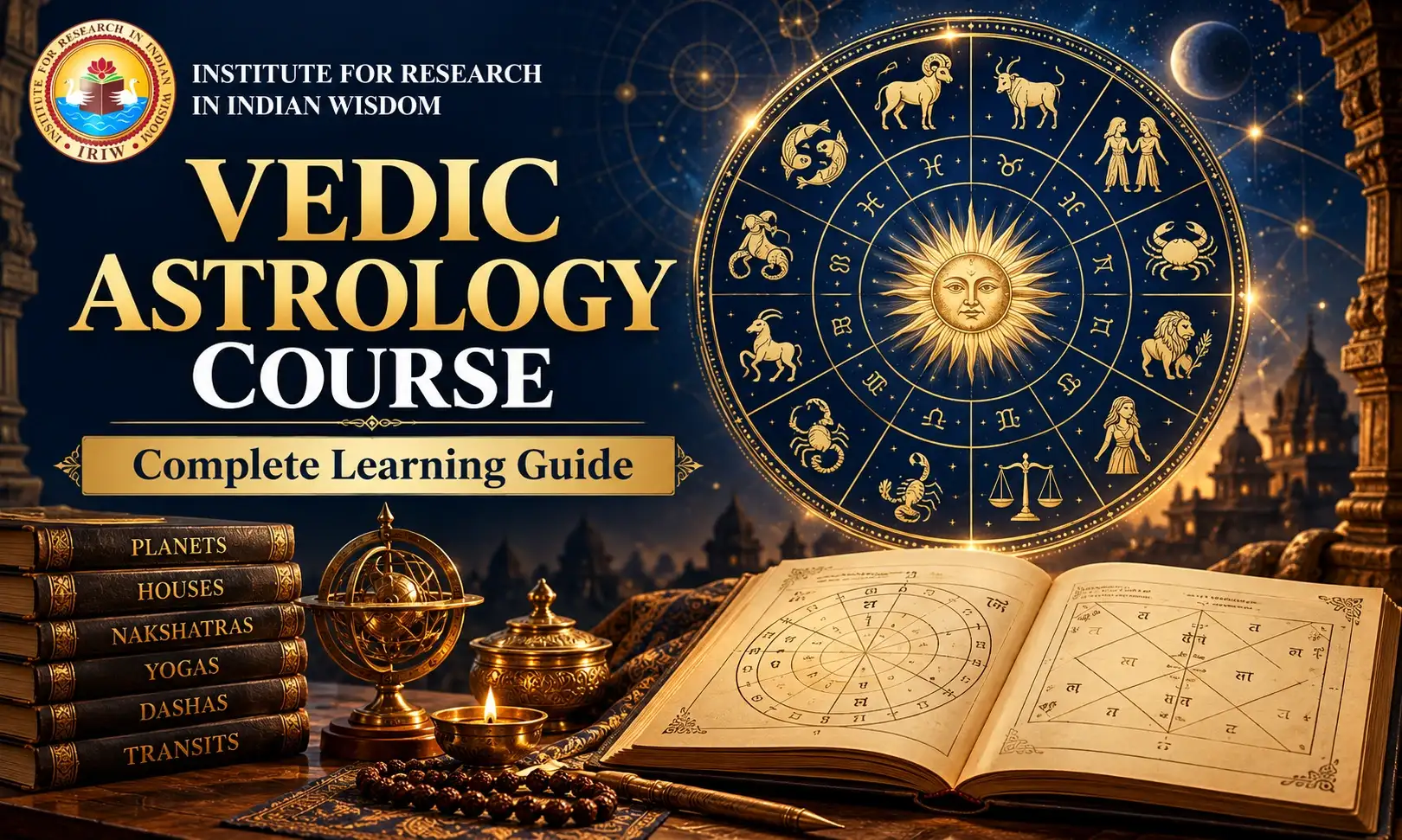
A Vedic astrology course gives learners a structured way to study Jyotish instead of collecting disconnected meanings from books, videos and social media. The subject has a large vocabulary, and every chart combines several factors at once. A course can help students learn those factors in the right order, understand how interpretations are formed and practise under the guidance of experienced teachers.
In India, people join Vedic astrology classes for different reasons. Some want to understand an important Indian knowledge tradition. Some are interested in birth-chart reading for personal study, while others are exploring astrology training as the beginning of a professional path. Whatever the goal, a suitable programme should teach method, context and ethical responsibility rather than promise instant mastery or guaranteed predictions.
This complete guide explains what a Vedic astrology course should cover, how beginner and advanced levels differ, what online learning involves, how to compare institutes and what to verify before enrolling. It also outlines IRIW's published learning pathway so that prospective students can make a more informed decision.
A Vedic astrology course is an organised programme for studying Jyotish, the Indian tradition of interpreting celestial positions through a horoscope or birth chart. It generally begins with signs, planets, houses and the ascendant, then progresses toward planetary relationships, nakshatras, yogas, dashas, transits and chart synthesis. The exact syllabus depends on whether the programme is introductory, intermediate or advanced.
A useful course does not treat each placement as an isolated statement. It teaches students to ask how the sign, house, lordship, strength, aspect and timing context modify one another. This is why formal astrology training can be easier to follow than random self-study: the learner receives a sequence, examples and a framework for testing interpretations.
Vedic astrology is a traditional interpretive discipline, not a substitute for evidence-based professional advice. Responsible teaching should encourage learners to avoid fear-based claims and to keep astrology separate from medical diagnosis, legal direction, psychological treatment or financial recommendations.
Most foundation-level courses are designed for learners without prior knowledge. Students, working professionals, homemakers, retirees, spiritual learners, writers and people interested in Indian traditions may all find the subject engaging. Mathematical expertise is not normally required at the start because software can calculate charts, although learners should understand what the calculations represent and why accurate birth data matters.
A Jyotish course is particularly suitable for people who enjoy patient observation, symbolic language, pattern recognition and continued study. It is less suitable for anyone looking for a shortcut to certainty. Chart interpretation improves through revision, comparison, feedback and humility; one course can provide a foundation, but competence develops over time.
A complete learning programme should progress from chart orientation to interpretation. Names and module order may vary, but a sound curriculum usually includes the following areas.
Students first need to understand what a horoscope represents. Introductory astronomy explains the apparent movement of celestial bodies, the horizon, the ascendant and the importance of time and place. Learners should also become comfortable with the chart style used by the course and recognise the twelve houses without depending entirely on software labels.
The grahas, or planets used in Jyotish, represent different functions and significations. Rashis describe modes of expression, while bhavas organise the chart into areas of life. A good course clearly separates these three layers before showing how a planet behaves according to its sign, house position and lordship. This prevents the common beginner mistake of treating a sign and a house as interchangeable.
The lagna or ascendant provides the chart's house structure and changes with birth time and location. The Moon is also given considerable interpretive importance in Vedic astrology. Nakshatras add another layer by dividing the zodiac into lunar mansions. Beginners should first understand their purpose and framework before attempting detailed predictive use.
Interpretation depends on condition as well as placement. Astrology classes may introduce concepts such as rulership, exaltation, debilitation, friendship, conjunctions and aspects. These principles help learners move beyond fixed keywords. The teacher should demonstrate how supportive and challenging indicators are weighed together rather than declaring a planet universally positive or negative.
Once students understand the chart foundation, they can begin studying combinations and timing. Yogas describe particular configurations, dashas organise planetary periods, and transits examine current movement in relation to a chart. These techniques require careful sequencing because timing methods are difficult to use responsibly when the natal chart has not been interpreted first.
Synthesis is the point at which separate rules become a coherent reading. Learners should practise identifying repeated themes, distinguishing strong evidence from a single indication and explaining conclusions in plain language. Guided examples, written exercises and faculty feedback are valuable because they reveal whether a student understands the method or has only memorised definitions.
By the end of a foundation programme, a learner should be able to navigate a chart, identify the ascendant, locate planets and house lords, and explain the basic role of signs, houses and planetary condition. The student should also be able to write a limited interpretation that cites more than one supporting factor and clearly separates observation from assumption.
A course should also improve learning habits. Students need a method for checking birth data, recording chart settings, revising terminology and asking focused questions. They should understand when a conclusion is uncertain and when a subject lies beyond their current level. These outcomes are more useful than a long list of memorised combinations because they prepare the learner for advanced study and responsible practice.
Before choosing a programme, identify the level that matches your current knowledge. Joining an advanced course too early can create confusion, while repeating basic content may not help an experienced learner. The following comparison shows the usual difference between foundation and advanced study.
| Learning area | Beginner level | Advanced level |
|---|---|---|
| Starting point | No prior knowledge required | Strong command of chart foundations |
| Core focus | Signs, planets, houses and chart layout | Deeper synthesis and predictive techniques |
| Timing tools | Conceptual introduction | Detailed use of dashas and transits |
| Practice | Guided observations and simple charts | Complex charts, cases and layered analysis |
| Outcome | Ability to understand basic chart logic | Greater interpretive depth and professional preparation |
| Next step | Consistent practice and advanced study | Specialisation, supervision and ethical application |
The most effective approach is progressive. Each stage should have a clear learning outcome, and students should be able to apply one level before moving to the next.
Progress should be measured through the quality of reasoning, not the number of rules memorised. A student who can explain why an interpretation is supported has learned more than someone who can recall hundreds of isolated combinations.
Self-study offers flexibility and access to many books and videos, but beginners often struggle with sequence and conflicting explanations. An online Vedic astrology course can provide a curriculum, scheduled learning and access to teachers while allowing students to participate from different parts of India.
Online formats vary. Some classes are live, some are recorded and others combine both. Live sessions can support questions and discussion, while recordings help with revision. Before enrolling, ask whether missed classes can be reviewed, how long lesson access remains available, whether notes are included and how assignments or chart exercises are evaluated.
Independent reading still matters. It can deepen classroom learning when the student follows the same framework, keeps a chart journal and brings questions back to the instructor. Mixing multiple traditions and software settings too early, however, can make the foundation less clear.
Do not select a course only because it uses phrases such as best, complete or certified. Compare what is actually taught and how learning is supported. The syllabus should identify the level, faculty should be visible, and the institute should explain its delivery format, language options, practice method and certificate requirements.
Look for a course that treats chart interpretation as a reasoned process. Sample lessons, curriculum details, faculty profiles and learner feedback can help you judge clarity. Reviews are useful, but they should not replace your own checks. Ask whether the programme suits a complete beginner, an experienced learner or someone planning professional practice.
Certification also needs context. A certificate confirms that a learner completed stated requirements; it does not guarantee expertise, employment, clients or income. Competence requires further practice and responsible application after the course.
Course details can change between batches, so obtain the current information directly from the institute before making payment. A clear pre-enrolment conversation prevents avoidable misunderstandings.
The Institute for Research in Indian Wisdom was founded in 2010 by Dr. Pawan Sinha 'Guruji' and positions astrology within a wider ecosystem of Indian knowledge, research, publications, workshops and cultural learning. Its official website presents online astrology courses for learners in India and beyond.
IRIW's beginner course covers foundations of astrology, introductory astronomy, zodiac signs, chart analysis based on birth details and Vedic astrology. The institute states that its course is available in Hindi and English and that learners receive certification after completing the programme. Prospective students should confirm the current completion conditions with the admissions team.
For continued study, IRIW also publishes an advanced astrology course focused on deeper Vedic concepts, chart interpretation, predictive techniques and practical application. This creates a visible pathway from foundation learning to more advanced astrology training. The programme is associated with Dr. Pawan Sinha and an experienced faculty team, including senior teachers who have been part of IRIW since 2016.
Because fees, schedules, access arrangements and faculty availability may change, readers should request the latest prospectus or admission information directly from IRIW before enrolling.
A Vedic astrology course can support several directions, including personal study, research, writing, educational content, teaching assistance and, after sufficient preparation, independent consultations. Some learners combine astrology with an existing profession or explore it as a long-term area of study rather than an immediate career change.
Professional readiness cannot be measured by a certificate alone. Students need extensive chart practice, feedback, communication skills and clear ethical boundaries. Anyone offering consultations should protect birth data, obtain consent, avoid guaranteed outcomes and never use astrology to replace professional medical, legal, mental-health or financial advice.
Income claims should also be treated carefully. Course completion may create a foundation for future work, but no responsible institute can guarantee earnings. Reputation develops through knowledge, accurate communication, respect for clients and continuous learning.
Regular revision is more effective than occasional intensive study. After every class, rewrite key ideas in your own words and apply only the concepts already taught. Maintain a chart journal that records the birth data source, the technique used, the observation made and any faculty correction. This turns practice into a record of progress.
Use software as a calculation tool, not as a substitute for interpretation. Check date, time, location, time zone and chart settings before analysis. Study one system consistently at the beginning, revise terminology through flashcards and discuss uncertainties instead of hiding them behind confident language.
New students often rush toward prediction before understanding the birth chart. They may rely on one placement, copy software text or attach fixed negative labels to planets and houses. These habits weaken interpretation because charts contain interacting factors that must be examined together.
Another mistake is collecting remedies or combinations without learning when they apply. Students should also avoid sharing another person's chart without consent or making high-stakes claims beyond their competence. A sound Jyotish course should encourage careful reasoning, confidentiality and proportionate language.
A typical course teaches horoscope structure, signs, planets, houses, ascendant, planetary relationships, nakshatras and chart interpretation. Advanced programmes may add detailed yogas, dashas, transits and predictive methods.
Yes. A foundation course should assume no previous knowledge and introduce terminology step by step. Consistent revision and guided chart practice are more important than an academic background.
Jyotish is the traditional Indian discipline commonly referred to as Vedic astrology. Courses may use either term, although teaching lineages and specific methods can differ.
Basic concepts can be learned within a structured course, but confident chart synthesis requires sustained practice. Duration depends on the syllabus, class frequency, revision and the learner's starting level.
They can be effective when the syllabus is organised, teachers are accessible and students receive examples, practice and feedback. Confirm whether sessions are live, recorded or blended before enrolling.
Yes. IRIW states that its astrology course is available in Hindi and English. Ask which language is available for the current batch and whether study materials follow the same language.
No. Sanskrit can help with classical terms and source texts, but beginner courses taught in Hindi or English should explain the essential vocabulary as it is introduced.
Advanced calculations have a mathematical basis, but beginners do not normally need strong mathematics because software generates charts. They should still understand the inputs, chart settings and meaning of the calculations.
IRIW states that learners receive certification after course completion. Confirm the current attendance, assignment, assessment and other completion requirements directly with the institute.
Beginner training builds the chart foundation and basic interpretation method. Advanced training assumes that foundation and develops deeper synthesis, timing, predictive techniques and practical case analysis.
Fees vary according to duration, faculty, delivery format, support and included materials. Request the latest fee, inclusions, payment schedule and refund policy for the specific batch you are considering.
A course can start the learning path, but professional practice usually requires further study, extensive chart work, feedback, communication skills and ethical preparation.
This depends on the institute and batch. Ask whether software access, installation help or chart-calculation guidance is included and which settings the course uses.
Learners may explore consultations, writing, research, educational content or teaching support after developing sufficient competence. A certificate does not guarantee a job, clients or income.
Visit IRIW's official astrology course page or contact the institute for the current syllabus, fees, schedule, language options and admission process. Verify all commercial terms before payment.
If you want structured Vedic astrology classes guided by an established Indian wisdom institute, explore the IRIW Astrology Course for Beginners and the IRIW Advanced Astrology Course. Request the latest syllabus, batch schedule, teaching language, fees and certification requirements before choosing your level. For admission guidance, call +91-9412218954 or email Info@iriw.in and take the next step with a learning path that matches your present knowledge and long-term goals.